Culture and Traditions in Oman: Crafts, Music and Maritime Heritage
Oman’s cultural heritage is expressed in the work of its craftspeople and in the customs carried from one generation to the next. Metalworkers, silversmiths, goldsmiths, potters, weavers, builders and carvers have shaped objects for daily life as well as for ceremony. Their work combines practical skill with a distinctive sense of design.
Omanis have long adapted ideas and materials to local needs. Ancient communities built with stone, developed shipbuilding and navigation, used falaj irrigation—including channels and siphons that carried water across wadis—and worked copper. Although modern life has changed many occupations, traditional craftsmanship continues alongside newer methods.
The khanjar and silverwork
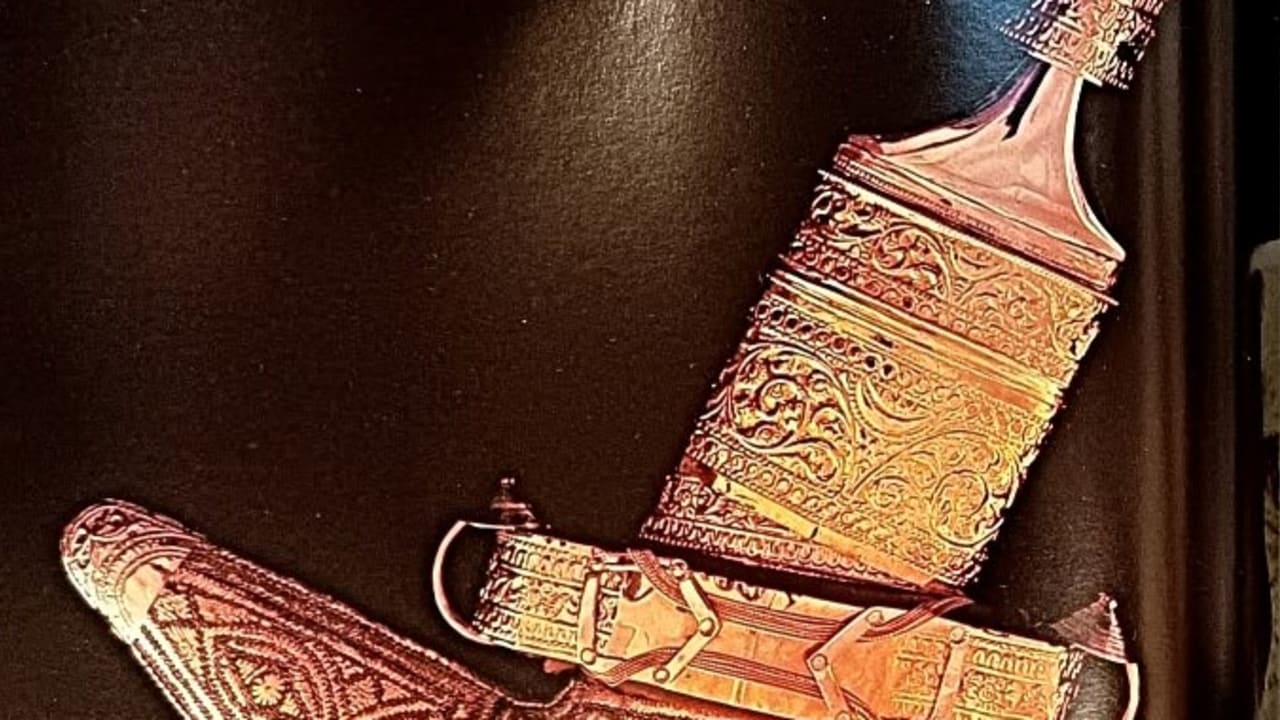
The khanjar is one of the best-known symbols of Oman. Its curved blade and decorated sheath distinguish it from daggers elsewhere in Arabia. Some khanjars are simple, with plain leather sheaths; others are richly ornamented. The Saidi style associated with the ruling family has a distinctive cross-shaped top. The design is linked in the historical account to Sayyid Said ibn Sultan and the early nineteenth century.
Khanjars are worn on locally made belts, sometimes woven with silver thread or decorated with silver buckles. Their handles and scabbards may be embellished with silver wire, bands or fine thread. The weapons are secured in a sheath and suspended at the waist. Silver rings and fittings can decorate the belt and sheath, while powder horns and small smoking pipes are among other traditional silver objects.
Silverwork is part of a wider tradition of Omani craftsmanship. Gold and silver have carried symbolic associations—the sun and moon in the account—and precious metals have long been used for jewellery, household objects and ceremonial items. Coffee pots, incense burners and rosewater sprinklers were made both for daily use and for formal occasions.
Jewellery and traditional dress
Omani jewellery varies by region and by occasion. Silver is especially prominent in many traditional pieces, while gold jewellery is also worn. Earrings, necklaces, bracelets, anklets, rings and hair ornaments are among the forms described. Some earrings are long and elaborate; necklaces may be made of linked coins or other silver pieces. Rings can be worn on several fingers, and heavier ornaments are sometimes kept for weddings and festivals.
Jewellery is part of dress as well as a store of wealth. Women’s ornaments can include chains, medallions, pendants and ear jewellery, while men may wear a khanjar and silver accessories. The materials and patterns differ across Oman: Dhofari ornaments, for example, have distinctive forms, and some pieces use coins or locally worked silver. Artisans make and repair jewellery using techniques such as hammering, filing and engraving.
Firearms, tools and metal vessels
Traditional matchlocks and other firearms were once carried by men in Oman’s interior. The matchlock described in the source had a long barrel, a wooden stock and a trigger mechanism; powder and a lead ball were loaded into the barrel. Although such weapons are no longer part of ordinary daily life, they remain part of the country’s historical material culture. Metalworkers also made agricultural tools, including spades, hoes, adzes and other implements used for cultivation and building.
Copper and brass household utensils were common in Nizwa, Mutrah and other towns. Cooking pots, kettles, bowls and round trays were used in homes. Copper coffee pots came in different sizes; large pots served tribal and family gatherings, while coffee was often transferred to smaller pots or flasks for serving. Traditionally, coffee was ground for each occasion.
Incense burners, rosewater sprinklers and finely chased coffee pots are among the metal vessels described. Frankincense was placed on hot embers in an incense burner, and the fragrant smoke was wafted over clothing or through a home. Rosewater sprinklers were used after meals and at formal gatherings. Some household pieces were decorated with engraved or chased patterns. Chests with brass fittings and nails were also found in homes.
Pottery and music
Pottery is a longstanding craft in Oman, with Bahla and Nizwa among the centres mentioned. Potters shape clay into cooking pots, water vessels and other household containers. The clay is prepared with locally available materials, then shaped, dried and fired. Some vessels are made in several stages, and decorative patterns may be added. The skill lies in judging the clay, forming an even shape and firing the pot without damaging it.
Pottery served everyday needs: vessels stored water, carried food and supported cooking. The source notes that modern glazes and methods have changed, and that some traditional finishes are no longer produced in the same way. It also describes the pride craftspeople take in work made by hand, despite the spread of factory-made goods.
Music accompanies social and festive occasions. Instruments mentioned include drums, stringed instruments and simple percussion. Songs can mark work, celebrations and communal gatherings. Some music has African influences, reflecting Oman’s long connections across the Indian Ocean. Traditional performance varies by region and occasion.
Dance, songs and celebrations
Omani tribes have distinctive airs and songs for bringing camels to water, loading, walking or trotting. Women sing at some celebrations, while men perform dances with swords and daggers. In a sword dance, participants move in formation, their blades catching the light as drums keep the rhythm. Ceremonial displays may include rifles, shields and the firing of blank rounds.
The source describes dances and songs at Eid celebrations and other gatherings. Drums beat in pairs, the crowd sways with the rhythm, and sword dancers move back and forth. Verses and choruses may praise God or greet visitors. These practices vary across the country, and the songs, instruments and movements are part of a living tradition.
Weaving and dyeing
Weaving continues in towns and villages, though many weavers are now older. Cotton is carded and spun before it is woven on a simple loom. Traditional looms may be made from palm fronds, and the weaver sits in a shallow pit with the warp threads stretched in front. The cloth is used for garments, wraps and household needs.
Bedouin women make articles from goat and camel hair, including cloth for tents, saddle bags, rugs and floor coverings. In Bahla, a black goat-hair cloak is woven with an embroidered panel. The wool of local sheep is also used for the bisht, a traditional cloak with gold edging worn over a white cotton dishdasha.
Dyeing has been practised for generations. Indigo was an important dye, including around Firq near Nizwa. The colour came from the leaves of the indigo plant. An attempt by Imam Said ibn Ahmad to make indigo dyeing a state monopoly in the eighteenth century reportedly made him unpopular. Craftspeople’s materials often came from their surroundings: indigo and goat hair locally, while shipwrights’ teak came from Malabar.
Omani boatbuilding and life at sea
Boatbuilding is an ancient craft, especially associated with Sur and Sohar, and historically also practised at Mutrah. The work is now concentrated among a small number of families who have continued the trade. Traditional boats were built from natural timbers, often teak imported from India. Builders used adzes, saws, chisels, hammers and bow drills. A framework of poles supported the hull during construction.
Earlier Omani vessels were sewn together with cordage made from bark, rather than joined only with nails. This method gave the planks flexibility in storms, though a ship could break apart more quickly in a wreck. Later boats used iron nails. The baghala and the smaller ghanja, associated with Sur, had high sterns and windows reminiscent of older Portuguese galleons. Other vessels included the bum, the huri, the abra and small fishing boats. A small dug-out or dinghy was called a huri; a ferry was an abra, while a palm-frond boat on the Batinah coast was a shasha. The word manwa was used for a warship.
Oman’s larger ships sailed long distances and carried goods such as dates and frankincense. One vessel described by the writer Alan Villiers, the Hope of Compassion, was about 200 tons and could carry thousands of packages of dates. Older ships were larger still. By the 1930s, the baghala was becoming less common as motor-powered craft took its place.
Accounts of life aboard these boats describe days beginning before dawn, with the call to prayer and the routine of cooking, fishing, cleaning, eating and working. Sailors repaired sails and rigging, prepared food and maintained the vessel. The crew could include Omani sailors and men from other communities around the Indian Ocean. A ship was not only a means of transport; it was also a home and workplace for everyone aboard.
Wood carving and decorated doors
Wood carving is another highly developed Omani craft. Carved doorways are features of towns and villages, from modest homes to large houses and forts. Designs include flowers, leaves and geometric patterns. Some doors carry inscriptions from the Qur’an and the date they were made. The style is found across Oman and in parts of East Africa, reflecting centuries of maritime contact and exchange.
Carvers also decorated the sterns and poops of boats, particularly in Sur and Sohar. The great ocean-going ships once carried extensive carved work, but few survive. Traditional tools—including chisels, awls, adzes, hammers and bow drills—are still used by craftspeople. With simple tools and skilled hands, they continue to produce detailed work.
Scholarship, languages and written heritage
Oman has a long tradition of learning. Manuscripts and books were kept in private and public collections, and religious education was widespread before modern schooling was introduced. Some manuscripts were destroyed during periods of conflict, but scholars have continued to study Oman’s history, religion, poetry and genealogy.
Omani writers recorded the history of rulers and tribes. Works on genealogy are valued not only for family histories but also for the picture they provide of the society and tribal relationships of their time. The source names chroniclers and scholars from different centuries, and notes that historical writing, religious studies and poetry formed important parts of Oman’s intellectual life.
Arabic is the principal language of Oman, but the country also has languages associated with its southern and coastal communities. Jibali, also called Shahri, Mehri, Harsusi and Bathari are among the languages discussed, along with the language of Socotra. These are related to the older South Arabian language family. Some are spoken by communities in Dhofar and the southern region, and their vocabulary and pronunciation reflect a long history of local use and contact.
Inscriptions in Dhofar and elsewhere provide evidence of ancient writing and trade. The source describes links between southern Arabia, the frankincense routes and communities across the Arabian Sea. Archaeological sites such as Sumhuram and Khor Rori are associated with this history. Remains of settlements, inscriptions and objects help researchers understand the region’s connections with the wider Indian Ocean world.
Rock art and ancient cultural evidence
Rock art is one of the oldest forms of cultural evidence in Oman. Figures and symbols were pecked or carved into stone, sometimes showing people, animals, weapons, hunting and travel. Some images are simple outlines; others are more detailed. Their subjects include horses, camels, cattle and wild animals, as well as people carrying tools or weapons.
These images offer clues about the people who made them and the landscapes they inhabited. They can suggest movement along trade and migration routes, the importance of animals, and changing ways of life. Together with inscriptions, archaeological sites and surviving crafts, rock art is part of Oman’s rich cultural record.
From the khanjar and silver jewellery to woven cloaks, pottery, boats, carved doors, scholarship and ancient rock art, Oman’s cultural heritage is both practical and expressive. It reflects local materials, regional traditions and generations of exchange across Arabia and the Indian Ocean.
Written by Farees
Travel writer and founder of Oman Explorer. Based in Muscat, Oman, with years of experience exploring the Sultanate's hidden gems, ancient forts, stunning wadis, and desert landscapes. Passionate about sharing authentic travel experiences and helping visitors discover the beauty of Oman.
Learn more about the authorMore Articles to Explore
Comments (0)
Sign in to comment
Create a free account or sign in to join the conversation.
No comments yet. Be the first to comment!