Sauna vs. Hammam: What's the Difference?
Picture two rooms, both hot, both ancient, both used by millions of people around the world for centuries. One is built from pine and cedar, heated by a pile of volcanic rocks. The other is clad in marble, filled with dense humid steam. They both make you sweat. They both leave you feeling restored. And they are, in almost every meaningful way, completely different experiences.
The sauna and the hammam are two of the oldest heat therapy traditions in the world — one born from the frozen forests of Scandinavia, the other from the bathhouse culture of the Ottoman Empire. Despite being regularly confused or lumped together under the generic label of "steam room," they differ in temperature, humidity, materials, ritual, health benefits, and cultural philosophy.
Understanding those differences is not just an academic exercise. If you are considering adding heat therapy to your wellness routine — whether at a spa, a gym, or at home — knowing what each tradition actually offers helps you choose intelligently, use each one correctly, and get the most from both.
Two Traditions, Two Very Different Worlds
The Finnish Sauna: Heat as a Way of Life
The sauna is one of Finland's defining cultural institutions. There are approximately 3.2 million saunas in a country of just 5.5 million people — more saunas than cars. For Finns, the sauna is not a luxury amenity or a gym perk. It is where children are bathed, where important conversations happen, and where the body and mind are restored after a hard day's work. In December 2020, UNESCO formally recognised Finnish sauna culture on its Representative List of the Intangible Cultural Heritage of Humanity — the first Finnish tradition to receive that distinction.
The word löyly (pronounced roughly "loy-loo") captures what makes the Finnish sauna experience unique. It refers to the steam that rises when water is thrown onto the hot stones of the kiuas (the sauna heater) — but in Finnish culture, löyly also carries connotations of spirit and breath. The steam is not just vapour; it is the soul of the sauna. How a sauna produces its löyly — the density of the steam, its softness, the way heat hits the skin — is taken seriously by Finns in the same way wine enthusiasts talk about terroir.
Historically, the sauna predates almost every other structure in Finnish life. Early saunas were dug into hillsides, lined with stone and earth, and used as much for practical survival as for wellness. Births took place in saunas because they were the cleanest and warmest spaces available. The sick were brought there to recover. Animals were sometimes sheltered there in winter. The sauna was not a retreat from daily life — it was woven into it.
The Hammam: Ritual, Community, and the Marble Room
The hammam — also called a Turkish bath — has an equally deep history, though one rooted in a different geography and cultural context. Its origins trace to the Roman thermae: the grand public bathhouses that were central to civic life across the Roman Empire. When the Ottoman Empire absorbed Byzantine Constantinople in 1453, Sultan Mehmed II commissioned the city's first major hammams almost immediately. Architects including the great Mimar Sinan — designer of the Süleymaniye Mosque — went on to create some of Istanbul's most celebrated hammams, including the Çemberlitaş Hamam, which has been in continuous use since 1584.
The hammam evolved within the context of Islamic culture, where ritual cleanliness (tahara) before prayer is a religious obligation. The hammam became the social infrastructure through which this obligation was fulfilled — but it grew into something much larger than that. It was where wedding preparations took place, where business was conducted, where news traveled, and where women, in particular, had one of the few socially sanctioned spaces outside the home for community gathering.
The word hammam itself comes from the Arabic for "the spreader of warmth." It is an apt description. The hammam does not assault you with heat the way a Finnish sauna does. It wraps you in it — gradually, gently, building through a sequence of rooms before the main ritual of exfoliation and massage on the göbek taşı, the heated marble navel stone at the centre of the hot room.
The Fundamental Difference: Dry Heat vs. Wet Heat
Strip away the history, the architecture, and the ritual, and the core difference between a sauna and a hammam comes down to thermodynamics — specifically, the relationship between temperature and humidity.
The Sauna: High Temperature, Low Humidity
A traditional Finnish sauna operates at 80–100°C (176–212°F) with a relative humidity of around 10–20%. At those temperatures, sweat evaporates from the skin almost immediately. This is the key to how the body tolerates such extreme heat: the rapid evaporation of sweat carries heat away from the skin surface, allowing the body to sustain much higher ambient temperatures than would otherwise be possible. A healthy adult can typically remain in a properly run sauna for 10–20 minutes before the cardiovascular load becomes significant.
When water is thrown on the stones — the practice called löylyttäminen — it creates a burst of steam that temporarily raises the perceived heat (the "heat wave" sensation known as loyly). This is not about humidifying the air; it is about creating an intense, momentary surge of heat that opens the pores, accelerates sweating, and intensifies the physiological response. The humidity drops back almost immediately as the steam dissipates. The experience is one of controlled intensity.
The Hammam: Moderate Temperature, Near-Total Humidity
A traditional hammam operates at 40–55°C (104–131°F) — roughly half the temperature of a Finnish sauna — but at near-100% relative humidity. At 100% humidity, sweat cannot evaporate. The skin stays moist, the body warms gradually and evenly, and the experience feels enveloping rather than intense. Because the body's cooling mechanism (sweat evaporation) is effectively disabled by the saturated air, even these lower temperatures produce meaningful sweating and physiological response.
This is why the hammam feels fundamentally different even though both environments make you sweat. In a sauna, you feel the heat as a dry, penetrating force — an experience that demands a kind of mental discipline. In a hammam, you feel cradled by it. The warm marble beneath you, the steam around you, the gradual release of tension — it is a more passive, receptive experience.
| Feature | Sauna | Hammam |
|---|---|---|
| Temperature | 80–100°C | 40–55°C |
| Humidity | 10–20% | ~100% |
| Session Duration | 10–20 min per round | 45–90 min total |
Architecture and Materials: Wood vs. Marble
The Sauna Room
A traditional sauna is built from wood — typically softwoods such as pine, spruce, aspen, or cedar — because wood absorbs heat without becoming dangerously hot to the touch, handles the expansion and contraction of extreme temperature cycling, and produces the characteristic warm, resinous scent that is part of the sauna experience. The kiuas (heater) sits in the corner, topped with a pile of volcanic rocks that hold and radiate heat. Wooden benches rise in tiers, since heat stratifies vertically — the higher you sit, the hotter the ambient temperature.
The design is deliberately simple. There is no plumbing in the sauna room itself. There are no elaborate architectural flourishes. The sauna cabin is a functional object refined over centuries to do one thing well: create the conditions for löyly.
The Hammam Rooms
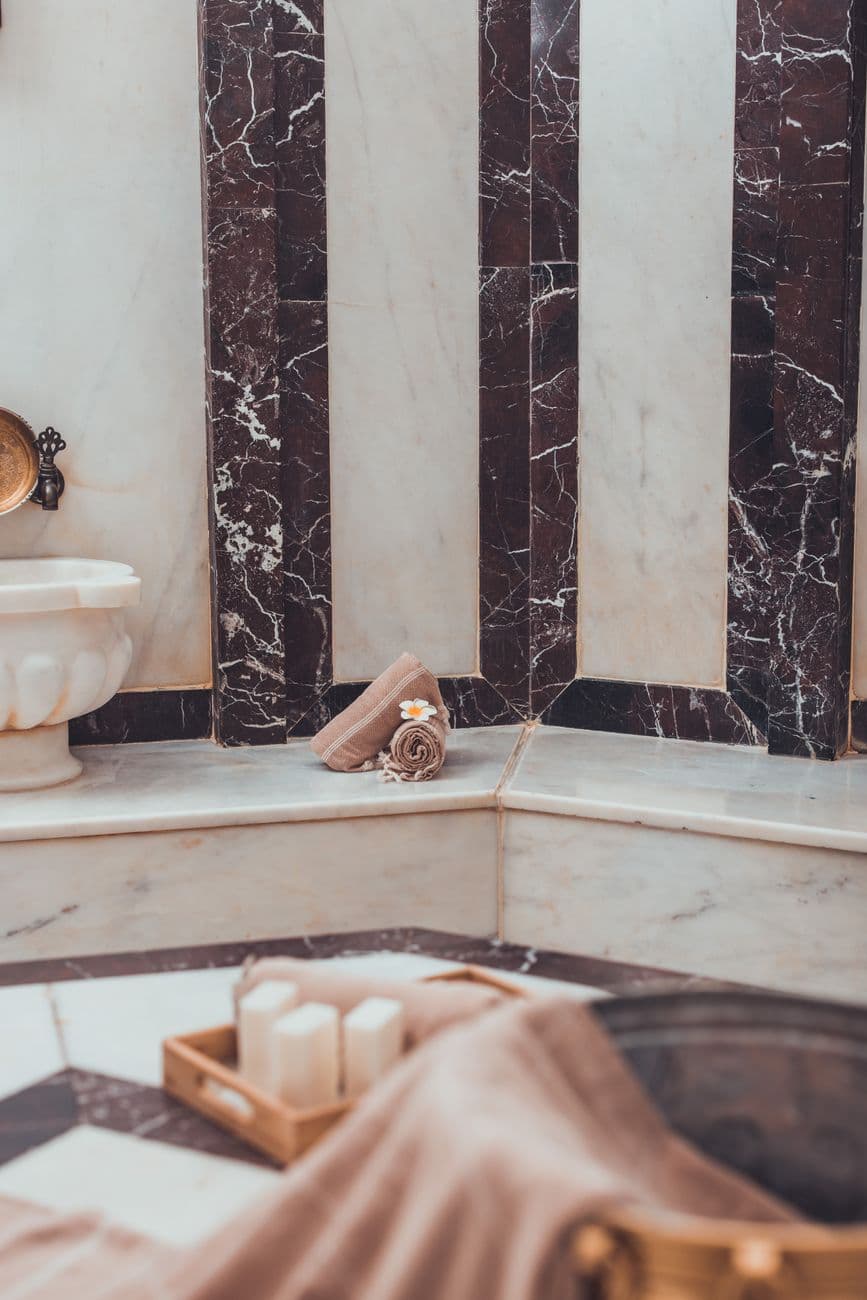
The hammam is architecturally complex by comparison — a multi-room sequence designed to progress the body through different thermal zones. A traditional hammam typically includes three interconnected spaces: the camekan (the changing room and social area), the ılıklık (a warm intermediate room for acclimatisation), and the sıcaklık (the hot room, where the main treatment takes place). At the centre of the sıcaklık sits the göbek taşı — the heated marble slab, often octagonal, around which the entire ritual is organized.
The materials are marble, ceramic tile, and stone — chosen for their ability to absorb and radiate humid heat, and to withstand constant moisture. Domed ceilings punctuated with small star-shaped skylights allow steam to circulate and create the diffused, atmospheric light that is characteristic of a traditional hammam. The architecture is deliberately beautiful. In the great Ottoman hammams, the space was designed to be a civic monument as much as a bathing facility.
The Rituals: What Actually Happens
A Sauna Session
The sauna experience is structured but not scripted. You enter the hot room, sit or lie on the wooden bench, and endure the heat. After 10–20 minutes — when the body's sweating response is well underway — you leave the sauna and cool down. This might mean a cold shower, a cold plunge pool, a roll in snow (in Finland), or simply standing in cool air. After cooling down and resting, you return for another round. Most experienced sauna users complete two to four rounds in a session.
The cold-hot alternation is not just custom; it is integral to the physiological effect. The contrast between extreme heat and cold creates a dramatic vascular response — blood vessels dilate in the heat, constrict sharply in the cold, and then dilate again as the body rewarms. This vascular cycling is believed to contribute significantly to the cardiovascular benefits associated with regular sauna use.
In Finland, the social dimension of the sauna is inseparable from the physical experience. Saunas are places where Finns say they are most themselves — where hierarchies flatten, conversations deepen, and the usual social armour comes off along with the clothing.
A Hammam Session
The hammam experience is more structured and typically guided by an attendant (historically called a tellak for men, kese or Tiyaba for women in Moroccan tradition). The progression through the rooms is choreographed.
- You enter the camekan, change into a peshtemal (a lightweight cotton or linen wrap) and wooden sandals.
- You move into the ılıklık — the warm room — where the body begins to acclimatise to the heat and humidity. Pores begin to open.
- You progress to the sıcaklık and lie on the göbek taşı. The heated marble warms you from below while the steam envelops you from all sides.
- An attendant performs the kese — exfoliation using a coarse mitt that removes layers of dead skin. This is often the most startling part for first-timers: the quantity of dead skin removed is remarkable.
- A foam massage follows: the attendant lathers the body in thick, fragrant soap bubbles using a cloth sack, then works through a full-body massage.
- The session ends in the cool room — the soğukluk — where you rest, drink tea, and allow the body to return gradually to its normal temperature.
The entire process, done properly, takes 60–90 minutes. It is a ceremony of renewal as much as a hygiene practice — and that ceremonial quality is part of what makes it culturally distinctive.
Health Benefits: Where the Evidence Points
Sauna: A Well-Researched Wellness Practice
The health evidence behind regular sauna use is unusually strong for a wellness intervention. The most significant body of research comes from the long-running Kuopio Ischaemic Heart Disease Risk Factor Study in Finland, led by professor Jari Laukkanen at the University of Eastern Finland. The landmark 2015 study — published in JAMA Internal Medicine and tracking 2,315 Finnish men over a median of 20.7 years — found that men who used the sauna four to seven times per week had a 63% lower risk of sudden cardiac death, a 48% lower risk of fatal coronary heart disease, and a 40% lower risk of all-cause mortality compared with once-weekly users.
A subsequent study extending the analysis to both men and women, published in BMC Medicine, confirmed that the risk of cardiovascular mortality decreased linearly with increasing sauna sessions per week — with no apparent threshold effect. Laukkanen's group has also published research linking frequent sauna use to reduced risk of stroke, hypertension, and dementia.
It is important to note that these are observational studies: they show a strong association between frequent sauna use and better cardiovascular outcomes, but cannot definitively prove causation. The mechanism — through improved endothelial function, reduced blood pressure, and cardiovascular conditioning from repeated heat stress — is physiologically plausible, and the dose-response relationship strengthens the case. Beyond cardiovascular effects, regular sauna use is associated with reduced muscle soreness, improved recovery, stress reduction, better sleep quality, and reduced frequency of respiratory infections.
Hammam: Skin, Breathing, and Deep Relaxation
The hammam's evidence base is less developed from a clinical standpoint, but the physiological rationale for its benefits is well-founded. The combination of humid heat and physical exfoliation produces measurable effects on the skin: pores open under the steam, dead skin cells are removed by the kese, and circulation to the skin surface increases. People with acne-prone, congested, or dull skin often report significant improvements from regular hammam sessions.
The high humidity environment has particular benefit for the respiratory system. Unlike dry sauna heat, which can feel harsh to some people with respiratory sensitivities, the moist warm air of the hammam gently opens nasal passages and airways. People with mild congestion, sinusitis, or dry breathing problems often find hammam sessions soothing in a way that saunas are not.
The foam massage component adds the benefits of physical manipulation — improved lymphatic drainage, muscle release, and the parasympathetic relaxation response associated with therapeutic touch. A well-executed hammam session is arguably more comprehensive as a skin care and physical therapy experience than a sauna session alone.
Common Misconceptions Worth Addressing
"They're basically the same thing."
They are not. A hammam is not a steam room and a sauna is not a dry hammam. The temperature differential alone (80–100°C versus 40–55°C) makes them physiologically distinct. The rituals, materials, cultural contexts, and primary benefits are all different. Confusing them is like confusing a pressure shower with a long bath — there is some surface overlap, but the experiences diverge in almost every meaningful way.
"The sauna is too hot — the hammam must be safer."
Temperature alone is not a complete indicator of physiological stress. Because the hammam's 100% humidity prevents sweat evaporation, the body cannot cool itself efficiently even at lower temperatures. Both environments place meaningful demands on the cardiovascular system. The same contraindications apply to both: people with uncontrolled hypertension, cardiovascular disease, or who are pregnant should consult a physician before using either.
"You detox your liver in the sauna."
Neither the sauna nor the hammam detoxifies the liver or kidneys. Those organs handle detoxification continuously and do not benefit from sweat-based "flushing." What sweat does do is help regulate body temperature and excrete very small amounts of trace compounds. The health benefits of regular sauna use are real — but they come through cardiovascular conditioning, heat shock protein production, and neurochemical responses, not through the elimination of toxins via sweat.
"The hammam is just a steam room."
A steam room and a hammam share the principle of humid heat, but a traditional hammam is an entirely different experience: it involves a specific architectural sequence, professional attendants, physical exfoliation, and a structured ritual that steam rooms at gyms simply do not replicate. A steam room is a thermal chamber. A hammam is a ceremony.
Sauna or Hammam: How to Choose
The right choice depends on what you are trying to achieve — and there is no universally correct answer.
- Choose a sauna if your primary goals are cardiovascular conditioning, muscle recovery, stress relief, or building a regular heat practice with strong research backing.
- Choose a hammam if your priorities are skin health, respiratory comfort, deep physical exfoliation, or a more guided, ceremonial experience.
- Choose a sauna if you prefer intense, controlled heat that demands active engagement — sitting with the discomfort, managing your breathing, deciding when to exit.
- Choose a hammam if you prefer to be guided through a gentler thermal journey with professional treatment.
- Choose a sauna if you are building a home wellness practice — high-quality residential saunas are more widely available and practical for home installation than full hammam setups.
One option that is increasingly popular among serious wellness practitioners is using both, in sequence. Starting with a sauna to initiate heavy sweating and cardiovascular activation, then transitioning to a hammam environment for exfoliation and skin treatment, produces a cumulative effect that neither modality achieves alone. Some high-end spas offer exactly this circuit.
Bringing Heat Therapy Home
For most people, the sauna is the more practical home wellness investment. A properly designed home sauna — whether a traditional Finnish-style wood-heated cabin, an electric sauna, or an infrared model — can be installed in a garden, garage, or basement without significant structural work. The operational costs are reasonable, and the research supporting regular use is compelling enough that many wellness-oriented homeowners treat it as a long-term health investment rather than a luxury purchase.
Understanding the differences between heat therapy options — sauna types, construction materials, heater designs, and optimal session protocols — is essential to making a good decision. Sauna suppliers like Orivon Wellness provide educational resources on their website covering the full spectrum of home heat therapy options, from infrared to traditional Finnish saunas and outdoor cedar models, which can help homeowners navigate the choices before committing to an installation.
A home hammam is considerably more involved — it requires waterproof materials, a steam generator, dedicated plumbing, and ideally a tiled or marble-clad space designed from the ground up. Some people incorporate hammam-style steam rooms into major bathroom renovations. For most homeowners, though, an authentic hammam experience remains something to seek out at dedicated spas and traditional bathhouses — which is perhaps as it should be, given how much of the hammam’s value lies in its social and ceremonial context.
Practical Tips for Getting the Most from Each
For the Sauna
- Hydrate before and after — you can lose 0.5–1 litre of fluid per session through sweating.
- Start with shorter sessions (8–10 minutes) and build tolerance before extending to 15–20 minutes.
- Take a proper cold cool-down between rounds — cold shower, cold plunge, or cool outdoor air. This is not optional for the full physiological benefit.
- Aim for two to four rounds per session, with 5–10 minutes of rest between each.
- Avoid alcohol before sauna — it significantly increases the risk of heat-related cardiovascular events.
- Frequency matters more than duration. Three to four sessions per week produces better outcomes than one very long session.
For the Hammam
- If it is your first time, let the attendant lead — the sequence and timing are optimised. Do not rush through the rooms.
- Drink water before you go. The steam environment is deceptively dehydrating despite feeling cool.
- The kese exfoliation can feel aggressive — communicate with the attendant about intensity. First-timers often have more dead skin to remove than they expect.
- Do not apply moisturiser before the session. Clean, dry skin exfoliates better.
- Rest fully in the cool room afterward and allow your body temperature to normalise gradually. The post-hammam rest is part of the treatment, not an afterthought.
- If you have very sensitive skin, mention this before the kese begins. The exfoliation can be adjusted.
Takeaways
The sauna and the hammam are both ancient, proven, and genuinely beneficial heat therapy practices — but they are not interchangeable. They work through different mechanisms, serve different wellness goals, and produce different experiences.
The sauna offers dry, intense heat that produces heavy sweating, strong cardiovascular conditioning, and a body of research suggesting meaningful long-term health benefits with regular use. It is demanding, meditative, and deeply Finnish in its cultural DNA.
The hammam offers humid, enveloping heat combined with professional exfoliation and massage — an experience that is gentler on the cardiovascular system, better for the skin, and more communal in its social design. It is ceremony as much as therapy.
The most useful framing is not which one is better, but what you are trying to achieve. If you want cardiovascular resilience and a practice you can do independently at home several times per week, the sauna is the stronger choice. If you want transformative skin treatment, respiratory comfort, and a full-body ritual guided by someone who knows exactly what they are doing, seek out a traditional hammam.
Both traditions have survived thousands of years not because of marketing, but because of what they actually do for the people who use them. That is a reasonably good endorsement.
This guest post was contributed by the editorial team at Orivon Wellness, a North American wellness brand specialising in home sauna and cold plunge systems — including the Lumin Infrared Sauna Series, Auris Outdoor Cedar Sauna Series, and Frost Cold Plunge — designed for serious home wellness practitioners.
Written by Farees
Travel writer and founder of Oman Explorer. Based in Muscat, Oman, with years of experience exploring the Sultanate's hidden gems, ancient forts, stunning wadis, and desert landscapes. Passionate about sharing authentic travel experiences and helping visitors discover the beauty of Oman.
Learn more about the authorMore Articles to Explore



Comments (0)
Sign in to comment
Create a free account or sign in to join the conversation.
No comments yet. Be the first to comment!